REPORTS

Asia David Asia David

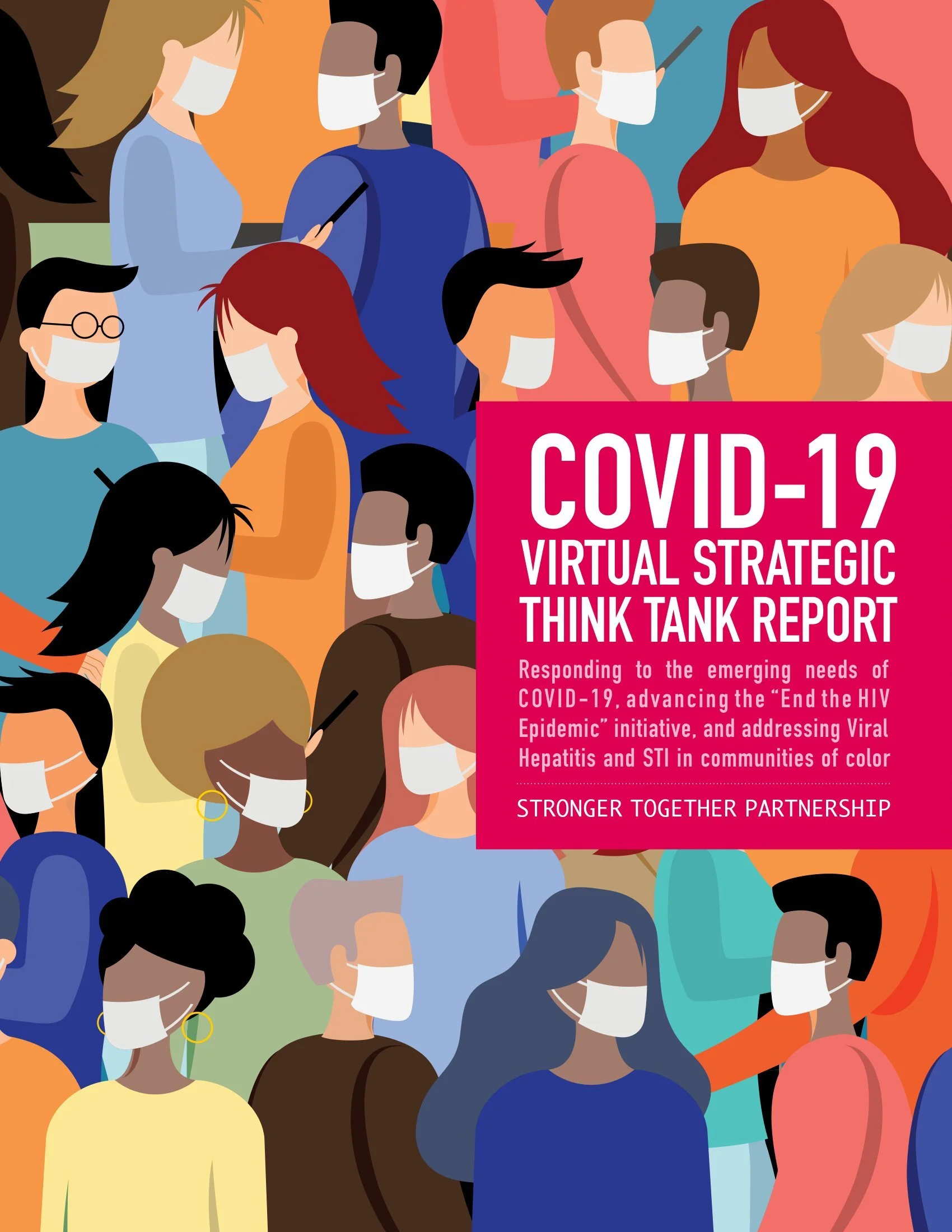
Stronger Together Partnership’s COVID-19 Virtual Think Tank – Final Report

Under the name of Stronger Together Partnership (STP), The Black AIDS Institute, San Francisco Community Health Center, and Latino Commission on AIDS, three organizations led by and serving people of color, have joined forces with other organizations to address the institutional challenges posed by the Novel Coronavirus (COVID-19) to the provision of HIV/STI/HCV services to communities of color in the U.S., Puerto Rico, U.S. Virgin Islands, and the Associated Pacific Island Jurisdictions.

This report produced by the Stronger Together Partnership highlights the key aspects of the planning and implementation process and 10 key recommendations aspiring from the discussions held during the COVID-19 Virtual Strategic Think Tank held on Oct 14, 2020.

Learn more about the Stronger Together Partnership here

Learn more about the COVID19 Virtual Strategic Think Tank here 

Under the name of Stronger Together Partnership (STP), The Black AIDS Institute, San Francisco Community Health Center, and Latino Commission on AIDS, three organizations led by and serving people of color, have joined forces with other organizations to address the institutional challenges posed by the Novel Coronavirus (COVID-19) to the provision of HIV/STI/HCV services to communities of color in the U.S., Puerto Rico, U.S. Virgin Islands, and the Associated Pacific Island Jurisdictions.

This report produced by the Stronger Together Partnership highlights the key aspects of the planning and implementation process and 10 key recommendations aspiring from the discussions held during the COVID-19 Virtual Strategic Think Tank held on Oct 14, 2020.

Learn more about the Stronger Together Partnership here

Learn more about the COVID19 Virtual Strategic Think Tank here

Download
Read More
Asia David Asia David

We The People

HIV is a disease that affects the most marginalized: Black and brown people, LGBTQ people, people living in poverty, people who don’t have housing, people experiencing substance addiction, and so many others who aren’t able to thrive simply because of who they are, who they love, or where they live. HIV is certainly not the only disease for which health disparities exist, but few health conditions match HIV in the degree to which it has affected those with the fewest resources to respond.

Scientifically, much has been revolutionized since the epidemic’s early days. Extraordinarily effective medications have been developed to slow the progression of the disease and to prevent further HIV transmission. In the near future, we are likely to have even more effective biomedical tools at our disposal—including long-acting, injectable antiretrovirals for both treatment and prevention and a plausible future of a cure and vaccine.

As optimism about available biomedical tools to fight HIV has increased, the HIV community has become more ambitious in its aspirations. Globally, in 2010 UNAIDS unveiled a vision of “getting to zero”—zero new HIV infections, zero discrimination, and zero AIDS-related deaths. That same year, the Obama administration unveiled the first National HIV/AIDS Strategy, which envisioned concerted action to reduce new infections and deaths.

HIV is a disease that affects the most marginalized: Black and brown people, LGBTQ people, people living in poverty, people who don’t have housing, people experiencing substance addiction, and so many others who aren’t able to thrive simply because of who they are, who they love, or where they live.HIV is certainly not the only disease for which health disparities exist, but few health conditions match HIV in the degree to which it has affected those with the fewest resources to respond.

Scientifically, much has been revolutionized since the epidemic’s early days. Extraordinarily effective medications have been developed to slow the progression of the disease and to prevent further HIV transmission. In the near future, we are likely to have even more effective biomedical tools at our disposal—including long-acting, injectable antiretrovirals for both treatment and prevention and a plausible future of a cure and vaccine.

As optimism about available biomedical tools to fight HIV has increased, the HIV community has become more ambitious in its aspirations. Globally, in 2010 UNAIDS unveiled a vision of “getting to zero”—zero new HIV infections, zero discrimination, and zero AIDS-related deaths. That same year, the Obama administration unveiled the first National HIV/AIDS Strategy, which envisioned concerted action to reduce new infections and deaths.

Download
Read More
Asia David Asia David

The State of Healthcare Access in Black America

The State of Healthcare Access in Black America initiative is a partnership between amfAR, AIDS United, George Washington University’s Milken Institute of Public Health, Harvard University’s Center for Health Law and Policy Innovation, the National Health Law Program, The Centeron Budget and Policy Priorities, National Black Justice Coalition and Georgetown…

The State of Healthcare Access in Black America initiative is a partnership between amfAR, AIDS United, George Washington University’s Milken Institute of Public Health, Harvard University’s Center for Health Law and Policy Innovation, the National Health Law Program, The Center on Budget and Policy Priorities, National Black Justice Coalition and Georgetown University’s O’Neill Institute for National and Global Health Law, National Black Gay Men’s Advocacy Coalition and Gilead Sciences.

Download
Read More